Stainless-steel pressure vessels and piping of a complete engineered gas generation system

Complete Engineered Systems

Gas Generators & Wastewater Treatment Plants

On-site nitrogen, oxygen and hydrogen generation, and wastewater treatment. Electris brings equipment, automation and monitoring together in a solution tailored to your facility.

COMPLETE ENGINEERING APPROACH

From your requirements to a working system

Requirements analysis

We start by defining the required capacity, gas specifications or treatment targets, operating schedule, available utilities and installation space. These requirements guide the choice of technology, equipment sizing and connections to your existing production process.

Technology & integration

Our gas generation solutions cover nitrogen, oxygen and hydrogen, with the technology selected according to the required flow, purity and pressure. For domestic and industrial wastewater, we offer compact containerised treatment plants developed with MAX INNOVATIONS–MI5. MI5 provides the treatment technology, while Electris handles the electrical systems, automation and monitoring.

MAX INNOVATIONS — MI5

Treatment technology

Electris

Electrical systems, automation and monitoring

Control & monitoring

The control system is designed around daily operation: process settings, operating data, alarms and parameter history. PLC control and SCADA or IoT integration can provide continuous monitoring, with remote access for diagnostics and adjustment where required.

  • PLC control
  • SCADA / IoT
  • Remote access

Industrial Gases Produced On-Site

Generators for Nitrogen, Oxygen and Hydrogen Production

Tailor-Made Solutions for Your Production Process

We provide tailor-made solutions for the supply of nitrogen, oxygen and hydrogen generators, with gas purity of up to 99.999%.

Nitrogen
Oxygen
Hydrogen

We place particular emphasis on reliable operation, safety and energy efficiency.

Our goal is to provide each client with a dependable on-site source of nitrogen, oxygen or hydrogen that operates in step with their production needs.

SCADA integration & monitoring

Our solutions can be connected to the client's SCADA system and configured for remote control and continuous monitoring of key process parameters.

On-site industrial gas generators at an Electris client site
Gas production at your site
Analysis

Analysis and sizing

Every project begins with an assessment of the application: the required gas flow rate, purity and pressure, operating pattern, available infrastructure and potential for future expansion. Based on these requirements, we select a customized configuration suited to the site.

Engineering

Build and integration

We combine technical expertise with a practical engineering approach, from selecting the production technology and sizing the equipment to integrating the system into the existing process.

Scope of work

Air preparation, PSA separation, buffer capacity, distribution interface.

Sizing, mechanical layout, electrical supply, instrumentation and control logic.

Handover

Commissioning and training

Functional testing, commissioning, documentation and operator guidance.

02 / Compact Water Purification Plants

Compact Water Purification Plants (containerized WWTP)

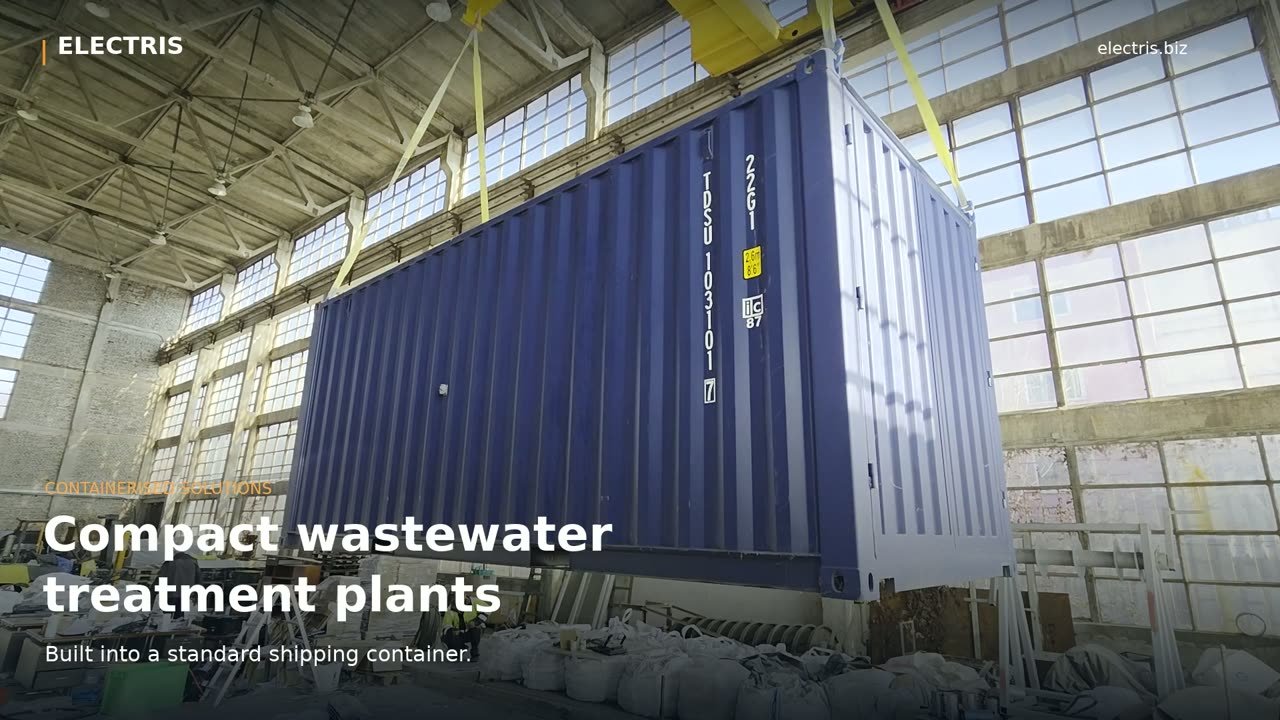
We offer compact wastewater treatment plants (WWTP) built into a standard shipping container. We develop them together with MAX INNOVATIONS - MI5, a Bulgarian manufacturer of treatment equipment: MI5 is responsible for the treatment technology, Electris for the electrical installation, the automation and the monitoring. The plants are designed for domestic wastewater and for wastewater from light and heavy industry, and they are used where conventional construction would take too long or is not possible at all: temporary sites, production plants, remote areas and emergency situations. When the work is finished, the container can be moved and put back into operation at another site.

Container module

Relocatable to another site

Fast connection

Fully assembled plant

PLC control

SCADA / IoT

Containerised wastewater treatment plant at an Electris client site
Water treatment in a compact module
Technology

Treatment adapted to the water

The treatment scheme is built around an SBR reactor with reagent dosing and is set up according to the composition of the incoming water, domestic or industrial, without being tied to a fixed process line. If the characteristics of the water change, the operating regime is adjusted. Magnetic reactors are used to accelerate the processes; they shorten the cycle times compared with conventional biological treatment, gravity settling and flotation. MI5 also has experience in the removal of radionuclides, and the spent filter media can be remediated after use.

Process scope

Pretreatment, filtration, membrane treatment, polishing, storage interface.

Engineering

Ready for connection

The plant is delivered complete and prepared for quick connection. The power supply is three-phase 3 × 400 V, the hydraulic connections are standard G2" / DN50, and the aeration compressor with pressure regulation is built into the container. For security of supply, a backup power source for at least two hours is provided, and where needed a hybrid configuration with photovoltaics and batteries is possible, for locations where the grid is unreliable.

Engineering

Hydraulic design, skid layout, instrumentation, controls and site connections.

Operation

Control and maintenance

Control is fully automated by PLC, with visualization on a SCADA / IoT platform that records the data continuously and keeps alarms and parameter history. Remote access over VPN and 4G allows diagnostics and optimization of the process without a visit to the site. The system monitors pH, suspended solids, COD and heavy metals, which makes it suitable for sites with strict discharge requirements as well. Level control, pump control, emergency modes and leak detection are part of the basic scope and reduce the operational risk.

Operation

Clear sequences, alarm handling, maintainable access and documented settings.

Types

Treatment types

Biological Wastewater Treatment
Treatment technology

Biological Wastewater Treatment

Biological treatment is the main stage for removing organic pollutants, expressed as BOD and COD, together with nitrogen and phosphorus. We use SBR reactors in which filling, aeration, settling and decanting take place one after another in the same tank, which removes the need for separate clarifiers and allows flexible adjustment to the load. Aeration is by a built-in compressor and the process is controlled automatically based on time and sensor readings. This stage is suitable for domestic wastewater and for biodegradable industrial wastewater, for example from the food industry.

Activated Carbon Filtration Plants
Treatment technology

Activated Carbon Filtration Plants

Activated carbon filters are used as a final stage to remove dissolved organic substances, residual petroleum products, colour, odour and micropollutants that biological treatment and filtration do not retain. The water passes through columns of granular activated carbon, and when the adsorption capacity is exhausted the carbon is replaced or regenerated. They are also used in preparing water for reuse and ahead of membrane filtration, to protect the membranes from organic fouling.

Treatment of Wastewater Containing Fats
Treatment technology

Treatment of Wastewater Containing Fats

Wastewater with a high content of fats and oils comes from meat and dairy processing, vegetable oil production and the food industry in general. The fats are removed ahead of the biological stage, because they form a crust in the reactors and block pipework and pumps. Grease separators to BDS EN 1825, flotation units and, where needed, coagulant dosing are used for this, and the separated fat is collected and disposed of as waste.

Kitchen Wastewater Treatment
Treatment technology

Kitchen Wastewater Treatment

Wastewater from restaurants, canteens and catering kitchens contains fats, food residues and detergents. The first stage is a grease separator to BDS EN 1825, sized according to the number of meals and the kitchen equipment; this is followed by settling of solids and, at larger sites, by biological treatment, so that the water meets the requirements for discharge into the sewer. Compact designs are suitable for installation in a basement or directly next to the building.

Emulsion Splitting Plants
Treatment technology

Emulsion Splitting Plants

Spent metalworking coolants, part-washing water and degreasing effluents are stable oil-in-water emulsions that do not separate by simple settling. The emulsion is broken by reagent dosing (acid, demulsifier, coagulant), after which the oil phase is separated by flotation or settling. An alternative is ultrafiltration with ceramic membranes, which leaves a small volume of concentrate for disposal and water fit for discharge or reuse.

Flotation Units
Treatment technology

Flotation Units

Dissolved air flotation (DAF) removes suspended solids, fats, oils and part of the COD by means of fine air bubbles that carry the pollutants to the surface, where they are collected as flotation sludge. It is preceded by coagulant and flocculant dosing to form large flocs. It is used on its own for the pre-treatment of industrial wastewater and as a stage ahead of biological treatment in the food, meat, dairy and petroleum refining industries, where gravity settling is too slow.

Neutralization Plants
Treatment technology

Neutralization Plants

Wastewater from electroplating shops, chemical production, regeneration of ion-exchange filters and boiler cleaning is acidic or alkaline and cannot be discharged until the pH is brought within the permitted range. Neutralization takes place in a reactor with automatic acid or alkali dosing according to the measured pH, with a mixer and control of the reaction time; where heavy metals are present, a stage for hydroxide precipitation and sludge separation is added. The plant can be built for continuous or batch operation, depending on the flow and the variation in composition.

Membrane Filtration
Treatment technology

Membrane Filtration

Membrane filtration covers micro- and ultrafiltration for the removal of suspended solids, bacteria and colloids, and nanofiltration and reverse osmosis for the removal of dissolved salts, heavy metals and organic substances. It is used as a final stage for water reuse, for concentrating the pollutants into a small volume and for preparing process water. The units are built with automatic membrane flushing and with control of pressure and flow, and the choice of membranes and the pre-treatment are based on a water analysis.

Complete-package delivery

Engineered before site. Verified in the real installation.

Pre-engineering reduces uncertainty only when every process and site interface has a clear owner—from the initial duty point to commissioning.

01 / Duty

Define

Required utility, quality, capacity, pressure and operating profile.

02 / Package

Configure

Process equipment, redundancy, controls and physical arrangement.

03 / Build

Assemble

Mechanical, electrical and instrumentation layers as one package.

04 / Site

Integrate

Utilities, distribution, signals, safety and operating interfaces.

05 / Proof

Commission

Functional testing against the defined operating requirement.

START WITH THE REQUIRED UTILITY

Define the output. Electris will engineer the complete route to deliver it.

Tell us about your process and the conditions at your site. We will review the requirements and propose a suitable technical configuration.

Let's Talk